Bulk Article Generation: SEOWriting.ai or Autoblogging.ai?
You need 200 articles published this month, and the tool you pick decides whether that happens. Some platforms cap bulk runs far lower, so the choice affects your whole content calendar.
This comparison covers what Autoblogging.ai and SEOWriting.ai each do for bulk generation, from CSV workflows and SERP analysis to credit pricing and publishing integrations. By the end, you will know which tool fits your volume, budget, and quality bar.
Quick Verdict: SEOWriting.ai or Autoblogging.ai for Bulk Article Generation?
If you need to generate up to 500 articles in a single batch with advanced SERP analysis, Autoblogging.ai is the clear winner; SEOWriting.ai is better for simpler, template-based bulk writing.
The two tools approach mass content production from different angles. Autoblogging.ai leans into AI content automation at scale, with bulk generation driven by CSV uploads and a deep feature set built for programmatic SEO. SEOWriting.ai focuses on approachable bulk writing that suits users who want speed and simplicity over advanced optimization.
| Feature Area | Autoblogging.ai | SEOWriting.ai |
|---|---|---|
| Bulk generation capacity | Up to 500 articles in a single batch via CSV | Bulk writing available, generally positioned for simpler template-based output |
| Advanced AI modes | 10+ AI modes, including Godlike Mode | Standard AI writing modes |
| SEO optimization | SERP competitor analysis, semantic SEO tools, 21-point SEO audit, featured snippet optimization | Basic on-page SEO options |
| Publishing | One-click WordPress publish | Publishing integrations available |
| Ease of use | Feature-rich, with a learning curve for advanced tools | Known for a simple, beginner-friendly interface |
| Best for | Scaling content operations, niche site automation, affiliate content | Smaller batches and users new to bulk writing |
Autoblogging.ai's track record supports the verdict. It is trusted by 40,000+ content creators and holds a 4.9 average rating, with 1M+ articles generated. Those numbers matter when you are committing to a tool for content scaling across many sites.
SEOWriting.ai has real strengths of its own. It tends to be easier to pick up and is often the more affordable entry point, which makes it a reasonable choice for bloggers producing modest volumes. Where it trails is depth: advanced SERP-driven optimization and high-volume batch generation are not its focus.
For readers running niche site automation or affiliate content at scale, the balance tips toward Autoblogging.ai. It pairs bulk capacity with semantic SEO tools, a human proofreader included in all plans, and 24/7 support. SEOWriting.ai remains a solid pick for simpler, template-based bulk writing, but it is the lighter option for serious mass content production.
At a glance: how Autoblogging.ai compares to SEOWriting.ai on the features that matter most.
| Feature | Autoblogging.ai | SEOWriting.ai |
|---|---|---|
| Bulk Article Generation | ✓ | ✓ |
What Is Autoblogging.ai?
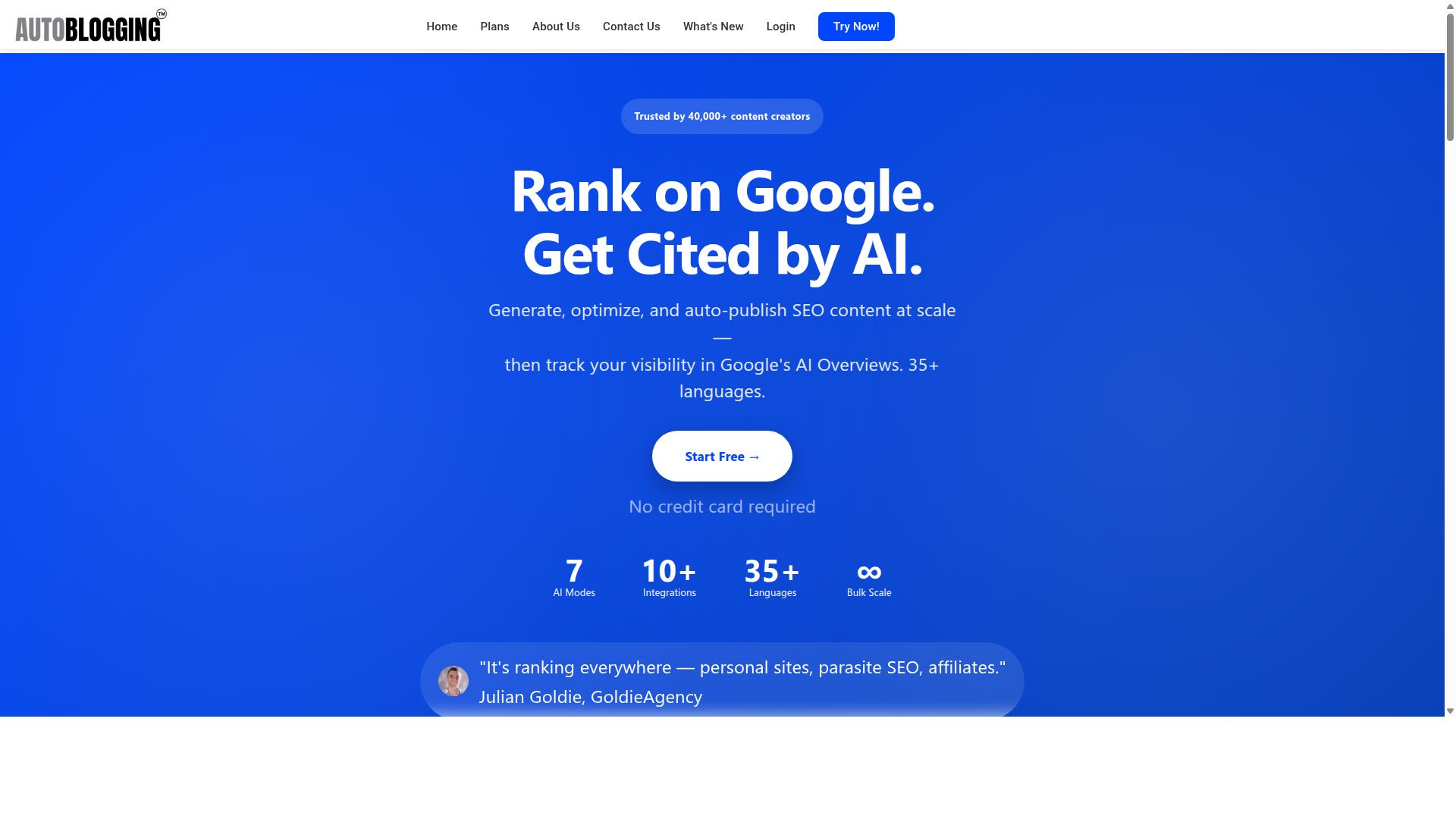
Autoblogging.ai is a SaaS platform launched in 2022 by founder Vaibhav Sharda, designed to automate bulk article generation for bloggers, agencies, and SEO professionals. It is a product of Digimetriq.com, and its mission is simple: help bloggers, website owners, and agencies save time and improve their online presence through cutting-edge technology.
The platform aims to cut down content costs and enable human counterparts in standard operating procedures with a strong first draft. For teams that want to move faster, Digimetriq's broader goal is to replace human counterparts entirely in repetitive content workflows.
Autoblogging.ai is used globally and trusted by over 40,000 content creators. That scale matters in a market full of AI writer comparison options, because it reflects a tool built for real production workloads rather than occasional one-off drafts.
Its feature set spans far beyond a single article generator. The platform includes Quick Mode, Godlike Mode with SERP competitor analysis, Bulk Generation, News Mode with Google News integration, and Amazon Reviews Mode. Optimization tools include Site Optimizer, Semantic SEO Analysis (a 21-point audit), Snippet Optimizer, Topical Maps, Intense Optimizer, Fan Out Queries, AI Infographics, Outreach Prospects, AI Proofreader, and Human Proofreader.
Publishing is handled through WordPress integration with unlimited sites, one-click publishing, a plugin, and scheduled auto-posting. Content can also go out to Web 2.0 platforms like Medium, Dev.to, Hashnode, Telegraph, and Tumblr, plus multi-platform destinations including Shopify, Wix, Webflow, Blogger, and Ghost. API, Zapier, and n8n connections support automation, and a Content Repurposer plus Done For You packages round out the offering.
Bulk Generation Mode: Up to 500 Articles via CSV
Autoblogging.ai's Bulk Generation Mode allows users to upload a CSV file containing up to 500 keywords or topics and automatically generate hundreds of articles in one go. For anyone serious about mass content production, this is the core of the platform's value.
The workflow is straightforward. You prepare a CSV with keywords, titles, or outlines, upload it to the platform, select your generation settings, and receive finished articles. Settings can include Godlike Mode, which applies SERP competitor analysis, LSI keywords, and knowledge graph extraction to inform each piece.
This structure supports programmatic SEO and niche site automation at a scale that manual drafting cannot match. Instead of writing one article at a time, you queue a batch and let the system work through it.
Credits are consumed per article, and unused credits roll over, so you are not forced to burn through a monthly allowance before it expires. That flexibility helps agencies plan around client cycles and seasonal publishing pushes.
Consider a practical example. An affiliate site owner wants to cover 100 buyer-intent keywords across a product category. They build a CSV with those 100 keywords, upload it, choose their settings, and generate the full batch. From there, the articles can be pushed to WordPress through one-click publishing, a plugin, or scheduled auto-posting, keeping the site refreshed without a manual upload for every post.
| Feature | Autoblogging.ai | SEOWriting.ai |
|---|---|---|
| Bulk generation from CSV | Up to 500 articles per batch | Bulk options available, limits vary by plan |
| SERP-based generation mode | Godlike Mode with competitor analysis, LSI keywords, knowledge graph extraction | General SEO-oriented generation settings |
| Credit rollover | Credits roll over | Terms vary by plan |
| WordPress publishing | Unlimited sites, one-click, plugin, scheduled auto-posting | Publishing integrations offered, scope varies |
The takeaway for content scaling is clear. If your priority is generating large volumes of SEO content from a simple keyword list, Bulk Generation Mode delivers the throughput, the settings depth, and the publishing pipeline in one place.
What Is SEOWriting.ai?
SEOWriting.ai is a cloud-based AI writing assistant that helps users create SEO-friendly articles, product descriptions, and other content using templates and AI models. It runs entirely in the browser, so there is nothing to install and no local setup to manage.
The platform is generally positioned as an affordable entry point into AI-assisted writing. Users typically describe it as approachable for freelancers, solo bloggers, and very small teams that want to produce content faster without committing to enterprise-level tooling.
Like many modern writing tools, it leans on large language models and natural language generation to draft text from a prompt, keyword, or outline. The workflow usually centers on picking a template, entering a topic or target keyword, and letting the system assemble a draft.
That template-driven approach is what makes it easy to learn. It also shapes what the tool does well and where it tends to feel limited, which matters once output volume starts to climb.
Core Capabilities and Typical Use Cases
SEOWriting.ai generally covers the basics that most content teams expect from a modern AI writer. It can generate long-form articles, blog posts, and product copy, and it typically includes some form of SEO guidance such as keyword placement suggestions or readability checks.
Many users pair it with WordPress publishing or export drafts manually. Some plans reportedly support bulk generation, meaning multiple articles can be queued or produced in a single session rather than one at a time.
Exact limits on bulk output are not something to assume. Anyone evaluating the tool for mass content production should verify current caps, credit systems, and per-article length directly, since these details change over time.
Typical use cases include:
- Blog posts and informational articles for niche sites
- Product descriptions for e-commerce catalogs
- Landing page copy and ad variations
- Outline generation and topic research support
- Repurposing existing content into new formats
For a single writer producing a handful of posts a week, that feature set is often enough. The friction tends to appear when volume, consistency, and hands-off publishing become the priority.
Who SEOWriting.ai Suits Best
The tool generally fits individuals and small teams that want a low-cost AI writer with a gentle learning curve. A freelance writer juggling a few clients, or a blogger publishing weekly, can often get value without a steep onboarding process.
It also appeals to users who prefer to stay involved in each draft. Because the workflow is template-led, the operator typically reviews, edits, and publishes manually, which suits people who want editorial control at every step.
Where it tends to feel less ideal is at scale. Teams running programmatic SEO across hundreds of pages, or affiliate operations managing multiple niche sites, often need more automation around scheduling, publishing, and internal linking than a general-purpose writer provides.
That is not a flaw so much as a scope difference. SEOWriting.ai reads as a writing assistant first, while some platforms in this category are built around AI content automation and end-to-end publishing pipelines.
For readers weighing bulk article generation options, the practical question is whether you want a tool that helps you write, or a system that writes and publishes on a schedule. SEOWriting.ai generally leans toward the former.
Features Compared
When comparing Autoblogging.ai and SEOWriting.ai, the key differentiators lie in bulk generation capacity, content quality features, and integration options. Both platforms belong to the AI content automation space and both can produce articles from a keyword or topic prompt, so the choice comes down to how far each tool scales and how deeply it optimizes what it writes.
Autoblogging.ai leans toward advanced SERP analysis and high-volume output. Its feature set includes Godlike Mode, Bulk Generation, News Mode, and Amazon Reviews Mode, along with optimization tools such as Site Optimizer, Semantic SEO Analysis, and Topical Maps. That combination suits teams doing mass content production, programmatic SEO, or niche site automation.
SEOWriting.ai, by contrast, emphasizes simplicity and template-based writing. Its appeal is a lower learning curve for users who want a straightforward AI writer comparison without a deep feature stack. The sections below break down where each tool stands on generation capacity, content quality, and publishing reach.
Bulk Generation Capacity and Workflow
Autoblogging.ai supports bulk generation of up to 500 articles via CSV upload, while SEOWriting.ai's bulk capabilities are more limited and suited for smaller batches. That single CSV workflow is the core of Autoblogging.ai's approach to content scaling: you prepare your keywords or topics in a spreadsheet, upload the file, and the platform works through the list in one session.
For anyone running affiliate content sites, programmatic SEO projects, or networks of niche blogs, this changes the economics of publishing. Instead of prompting an AI writer one article at a time, you queue an entire content calendar at once. Bulk Generation sits alongside Quick Mode for single pieces and Godlike Mode for deeper analysis, so the same account covers both small jobs and large runs.
SEOWriting.ai does offer a bulk generation feature, but its workflow typically involves more manual input per article or lower batch ceilings. That is not a flaw for a blogger publishing a handful of posts a week. It becomes a bottleneck when the goal is hundreds of pages per month.
Credit consumption is worth planning for on either platform. Higher-volume runs draw down credits faster, and deeper modes that perform competitor analysis use more resources per article than basic generation. A practical approach is to reserve advanced modes for priority pages and use faster modes for supporting content.
- Autoblogging.ai: up to 500 articles per CSV upload, one-session generation, multiple modes for different content types
- SEOWriting.ai: bulk generation available, generally smaller batches and more manual handling per article
- Best fit for Autoblogging.ai: mass content production, niche site automation, and programmatic SEO at scale
Content Quality: SERP Analysis, LSI Keywords, and Knowledge Graph Extraction
Autoblogging.ai's Godlike Mode performs SERP competitor analysis, extracts LSI keywords, and builds knowledge graphs to produce in-depth, SEO-optimized articles. This is where the platform separates itself from a straightforward template writer: the output is shaped by what already ranks, not just by the seed keyword.
Under the hood, this kind of work relies on natural language processing techniques such as entity extraction, named entity recognition, and topic modeling. Analyzing top-ranking pages helps surface the subtopics, related terms, and semantic relationships that search engines associate with a query. Latent semantic indexing, or LSI keywords, fills out the vocabulary a page needs to demonstrate topical depth.
Knowledge graph extraction goes a step further by mapping entities and their connections, which supports stronger semantic similarity between your content and the intent behind a search. For readers comparing an AI writer, the practical difference is coverage. A template-based article may hit the main keyword but miss the supporting concepts that make a page feel complete.
SEOWriting.ai generally relies more on templates and basic keyword insertion, which keeps output consistent but can limit topical depth on competitive queries. That approach works well for simple informational posts. It struggles where the top results are long, heavily structured, and rich in entities.
Autoblogging.ai also provides optimization tools that extend quality control beyond first draft generation:
- Semantic SEO Analysis: a 21-point audit of content
- Snippet Optimizer: targets featured snippet placement
- Topical Maps and Fan Out Queries: plan coverage across a subject
- AI Proofreader and Human Proofreader: catch errors before publishing
For affiliate content and niche site automation, that layered approach to SEO content tooling matters more than raw word count. An article spinner alternative produces text; a platform built around SERP analysis produces text with a reason to rank.
Publishing, Integrations, and Languages
Autoblogging.ai offers 35+ integrations including WordPress auto-posting and supports 35+ languages, while SEOWriting.ai provides basic integrations and fewer language options. Publishing directly to WordPress covers unlimited sites through one-click posting, a plugin, and scheduled auto-posting, which removes the copy-paste step from an automated blogging software workflow.
Beyond WordPress, Autoblogging.ai connects to Web 2.0 platforms such as Medium, Dev.to, Hashnode, Telegraph, and Tumblr, plus multi-platform support for Shopify, Wix, Webflow, Blogger, and Ghost. API access, Zapier, and n8n round out the options for teams that want AI content automation wired into an existing stack.
Language coverage is the other half of the story. Support for 35+ languages and worldwide availability makes the platform viable for multilingual SEO, whether you are building regional sites or translating a proven content model into new markets. A Content Reproducer and Done For You packages add further flexibility for different working styles.
SEOWriting.ai does offer integrations, though typically fewer than Autoblogging.ai and with a narrower set of publishing destinations. For a single-site blogger, that may be enough. For anyone managing multiple properties or serving international audiences, the wider integration and language range is the more practical foundation.
| Feature | Autoblogging.ai | SEOWriting.ai |
|---|---|---|
| Bulk generation | Up to 500 articles via CSV | Bulk feature available, generally smaller batches |
| SERP and semantic analysis | Godlike Mode with SERP competitor analysis, LSI keywords, knowledge graph extraction | Generally template and keyword based |
| WordPress publishing | Unlimited sites, one-click, plugin, scheduled auto-posting | Basic integrations |
| Languages | 35+ languages, worldwide | Fewer language options |
| Extras | API, Zapier, n8n, Content Reproducer, Done For You packages | Not specified here |
Read together, these three areas point in one direction. SEOWriting.ai is a reasonable entry point for simple, low-volume writing. Autoblogging.ai is built for scale, with the SERP-driven quality layer and publishing reach that large content operations depend on.
Pricing Compared
Pricing is a critical factor when choosing between Autoblogging.ai and SEOWriting.ai, as both offer tiered plans based on credits or word limits. The two tools approach cost in different ways, and the right fit depends on how much content you plan to produce each month.
Autoblogging.ai publishes clear monthly and annual rates, and every plan includes credit rollover, so unused capacity carries forward. SEOWriting.ai uses a credit or word-based structure that varies by tier, and its exact rates should be confirmed on the official website since they can change.
For anyone focused on bulk article generation, the deciding question is simple: how many articles does a dollar buy, and what happens to credits you do not use? The sections below break down each model so you can compare them side by side.
Autoblogging.ai Plans and Credit Value
Autoblogging.ai offers monthly plans starting at $19 for 40 credits, up to $999 for 5,000 credits, with annual discounts and credit rollover. One credit typically equals one article, which makes the math straightforward for bulk article generation.
Here is how the monthly tiers line up:
- Starter: $19 for 40 credits
- Regular: $49 for 120 credits
- Standard: $99 for 300 credits
- Gold: $179 for 600 credits
- Premium: $249 for 1,000 credits
- Enterprise: $999 for 5,000 credits
Annual billing lowers the effective monthly rate across every tier. For example, Starter drops to $12/mo ($148/year), Regular to $32/mo ($382/year), Standard to $64/mo ($772/year), Gold to $116/mo ($1,396/year), Premium to $162/mo ($1,942/year), and Enterprise to $649/mo ($7,792/year).
Two details matter for high-volume users. First, credits roll over on all plans, so a slow month does not wipe out your investment. Second, additional credits can be purchased when a project spikes. New accounts also get 10 free credits per month with no credit card required, which lets you test output quality before committing.
For agencies and teams running niche site automation or programmatic SEO at scale, the Enterprise tier and the Done For You packages give a path beyond self-serve credits. Payment options include Visa, MasterCard, American Express, and PayPal, with bank transfers available for annual enterprise plans, and you can cancel anytime.
SEOWriting.ai Plans and Credit Value
SEOWriting.ai offers subscription plans that are generally more affordable for low-volume users, but its credit system may not support large-scale bulk generation as efficiently. Its pricing appears to be organized around word credits or feature tiers rather than a simple article-per-credit model.
Because rates and inclusions can shift, the safest move is to check the official SEOWriting.ai website for current pricing before you commit. Do not rely on older comparison posts or screenshots, since subscription terms for AI writer comparison tools change often.
The practical trade-off comes down to capacity and flexibility. A word-based system can feel economical when you publish a handful of posts a month, yet it becomes harder to predict costs once you scale into mass content production.
Two gaps tend to show up for bulk users. First, credit rollover is not a standard feature across the category, so unused capacity may expire at the end of a billing cycle. Second, very high monthly volumes can push you into custom or enterprise conversations rather than a published self-serve tier.
That does not make SEOWriting.ai a weak tool. For occasional blogging or testing a new niche, a lower entry point has real appeal. The question is whether that model still fits once your output targets grow into the hundreds of articles per month.
If predictable per-article costs and rollover credits matter more than the lowest possible entry price, Autoblogging.ai's published tiers make budgeting for content scaling far easier to plan.
Who Should Choose Autoblogging.ai
Autoblogging.ai is ideal for SEO agencies, affiliate marketers, and niche site owners who need to produce hundreds of articles quickly and at scale. The platform was built for mass content production, not for writers who publish one post at a time.
Its verified audience spans bloggers, website owners, SEO professionals, marketing agencies, content creators, and affiliate marketers. That range matters, because it covers both solo operators and teams managing client work.
If your publishing schedule is measured in articles per week rather than posts per month, the fit is usually clear. The same applies to anyone running programmatic SEO projects across large keyword sets.
- SEO agencies handling content for multiple client websites
- Affiliate marketers building and scaling affiliate content sites
- Niche site owners running niche site automation across several properties
- Portfolio builders managing personal sites, parasite SEO pages, or local sites
- Content teams that need to support client websites alongside their own
These users share one trait: volume. They need content scaling that keeps pace with keyword research, not a tool that caps out after a handful of drafts.
Autoblogging.ai supports bulk generation of up to 500 articles, which suits agencies and portfolio owners far better than tools designed for occasional single posts. It also includes advanced SERP analysis and integrations, two features that matter when output has to stay aligned with search intent.
Social proof backs the positioning. Autoblogging.ai reports a user base of 40,000+ and a 4.9 rating, figures that suggest the platform holds up under real production workloads rather than demo conditions.
By contrast, SEOWriting.ai is often discussed as a general AI writing assistant for individual articles. That can work well for a single blog, but readers comparing AI writer comparison options for multi-site operations should weigh how each tool handles scale.
The takeaway: if your workflow involves client websites, portfolio sites, or affiliate content at volume, Autoblogging.ai is the stronger match. If you publish occasionally and only need one-off drafts, a lighter tool may be enough.
Who Should Choose SEOWriting.ai
SEOWriting.ai is better suited for individual bloggers, small businesses, or those new to AI writing who need a simple, budget-friendly tool for occasional content creation. If you publish a handful of posts each month and want a gentle learning curve, this type of tool can feel less intimidating than a full content automation platform.
These users typically care more about writing one solid article at a time than about mass content production. They may not need API integration, WordPress auto-posting, or scheduled publishing. A straightforward editor with a few templates is often enough.
Cost sensitivity also plays a role. For low-volume use, a lighter tool may feel more affordable than a platform built for content scaling. The trade-off is that growth can be harder later, since these tools are generally not designed for high-volume output.
Common profiles for this kind of tool include:
- Solopreneurs writing occasional blog posts or landing pages
- Small teams without a dedicated content workflow
- Beginners who want to learn AI writing before investing in automation
- Marketers testing a niche before committing to regular publishing
There is nothing wrong with starting simple. The question is whether your needs will stay small. Once you move toward bulk article generation, programmatic SEO, or niche site automation, a beginner-focused tool can start to feel limiting.
For readers with modest, occasional content needs, SEOWriting.ai can be a reasonable entry point. For anyone planning to scale output across many posts or sites, a platform built for AI content automation tends to be the stronger long-term choice.
Final Verdict
For high-volume bulk article generation, Autoblogging.ai emerges as the superior choice due to its advanced features, scalability, and proven track record. When the goal is mass content production for niche sites, affiliate content, or programmatic SEO, the platform's ability to produce up to 500 articles per batch puts it in a different category from tools built for smaller workloads.
Godlike Mode adds SERP analysis to the generation process, which matters for anyone competing on search visibility rather than simply filling a site with text. Combined with 35+ integrations and 35+ languages, the system fits naturally into WordPress auto-posting workflows and multilingual content scaling without forcing teams to rebuild their stack.
Credit rollover is another practical advantage for agencies and publishers whose output fluctuates month to month. Unused capacity is not wasted, which keeps the effective cost of large projects predictable. Round-the-clock support backs this up for users running automated blogging software around the clock.
The numbers behind the platform reinforce the case. A user base of 40,000+ and a 4.9 rating reflects sustained adoption rather than a short-lived spike in interest. For readers weighing an AI writer comparison, that scale of usage is a useful signal about reliability in day-to-day content operations.
| Criteria | Autoblogging.ai | SEOWriting.ai |
|---|---|---|
| Batch capacity | Up to 500 articles per batch | Better suited to smaller-scale output |
| SERP-driven mode | Godlike Mode with SERP analysis | General SEO writing features |
| Integrations | 35+ integrations | Limited, general integration options |
| Languages | 35+ languages | General multilingual support |
| Credit handling | Credit rollover | Varies by plan |
| Support | 24/7 support | Standard support hours |
SEOWriting.ai remains a viable option for smaller-scale needs. Teams publishing a handful of posts per week, or those testing AI content automation for the first time, may find a lighter tool adequate. The trade-off appears when volume rises and batch limits, language coverage, or workflow integrations start to constrain output.
For content scaling at scale, the deciding factors tend to be throughput, search-aware generation, and how well a tool connects to existing publishing systems. Autoblogging.ai addresses all three, while keeping credit usage flexible and support available at any hour. That combination is why it leads this comparison for bulk article generation.
Readers ready to move forward can reach the team directly. Autoblogging.ai is available by email at [email protected], by phone or WhatsApp at +91 84605-06553, and on Skype at vibes.yb, with support hours of 7:00 to 19:00 IST. The company also maintains offices in India at 501, Trinity Orion, Vesu, Surat - 395007, Gujarat, and in the United Kingdom at 2nd Flr, SEO Content Suite, 35 Water Ln, Wilmslow, Cheshire SK9 5AR, reachable at +44 1625 359056. You can also follow updates on Facebook, Twitter, and LinkedIn.
Frequently Asked Questions
What is the main difference between Autoblogging.ai and SEOWriting.ai for bulk article generation?
Both tools can generate articles at scale, but Autoblogging.ai is built around bulk workflows: its Bulk Generation mode produces up to 500 articles via CSV upload, and it offers 10+ AI modes including Godlike Mode with SERP competitor analysis, LSI keywords and knowledge graph extraction. Autoblogging.ai is also trusted by 40,000+ content creators and has generated 1M+ articles, so it is designed for bloggers, agencies and affiliate marketers who need volume plus quality control.
How does pricing compare between the two platforms?
Autoblogging.ai offers monthly plans starting at $19 for 40 credits and scaling up to $999 for 5,000 credits, with annual plans available and credits that roll over. SEOWriting.ai's published pricing starts at around $19 per month, with a free tier and annual discounts on some plans. Exact value depends on how many articles you need and which features matter most, so compare credit-to-output ratios for your own use case.
Can Autoblogging.ai handle large-scale bulk generation the way my agency needs?
Yes. Autoblogging.ai's Bulk Generation mode supports up to 500 articles at once via CSV, and its Enterprise plan provides 5,000 credits per month for high-volume operations. It serves marketing agencies, SEO professionals and affiliate marketers working across client sites, portfolio sites and local sites. Credits also roll over, so unused capacity is not lost month to month.
Does Autoblogging.ai offer quality features beyond just generating text?
Autoblogging.ai includes Godlike Mode, which performs SERP competitor analysis, extracts LSI keywords and builds knowledge graphs to inform each article. It also ships 35+ integrations, supports 35+ languages, and includes a human proofreader in applicable plans. New features are shipped weekly, so the platform continues to expand after you subscribe.
Which tool is better for someone who is brand new to AI content generation?
Autoblogging.ai offers a free Quick Mode with single and wizard options, so beginners can test the platform before committing to a paid plan. Paid plans start at $19 per month, and 24/7 support is available if you get stuck. SEOWriting.ai also has a free tier, so trying both at entry level is a reasonable way to see which interface suits you.
What kind of support and reliability can I expect from Autoblogging.ai?
Autoblogging.ai provides 24/7 support, holds a 4.9 average rating, and is available worldwide as an online SaaS product from Digimetriq.com. The company is led by founder Vaibhav Sharda, who has been automating processes since 2011, and the platform has been running since 2022. Testimonials come from users such as Julian Goldie, James Dooley and Bart Magera, which gives some indication of its track record in the SEO community.
Recommended Resources: